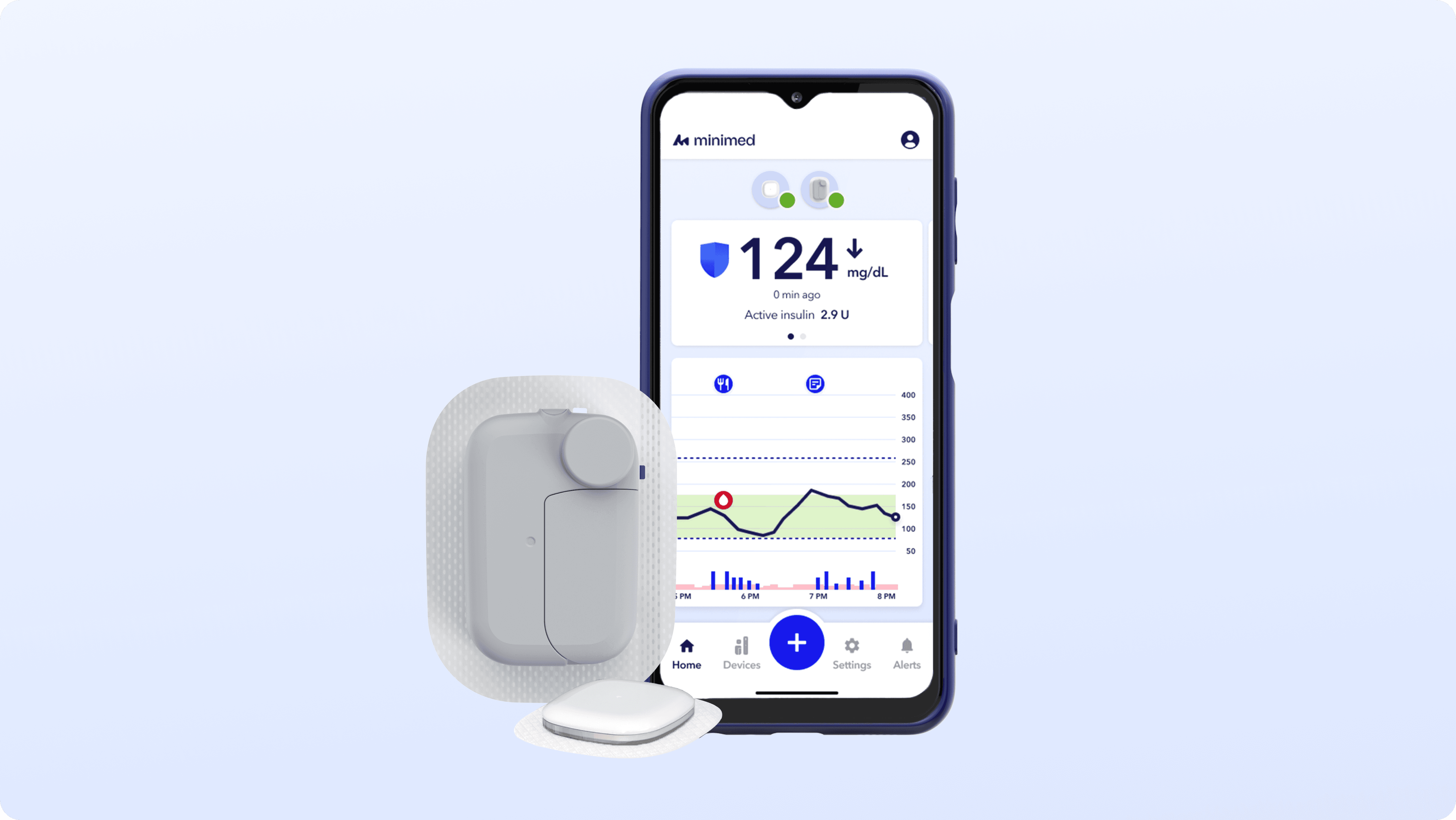
Medtronic is the world’s largest medical device company. The new patch pump system integrates a wearable insulin pump, continuous glucose monitor (CGM), and mobile app to deliver real-time insulin therapy for people living with diabetes. As the first 5-day, fully wireless patch pump, it expands portability and freedom. With that portability comes added system complexity to design for. Patients monitor their health status, devices, and insulin delivery, often in time-sensitive moments where clarity is critical.
Role
Senior UX/UI Designer
Team
Product, Engineering, Human Factors, Clinical, Regulatory
Company
Medtronic
Data Visualization
Systems
Usability
Error Handling
Visual Design
Cross-Platform
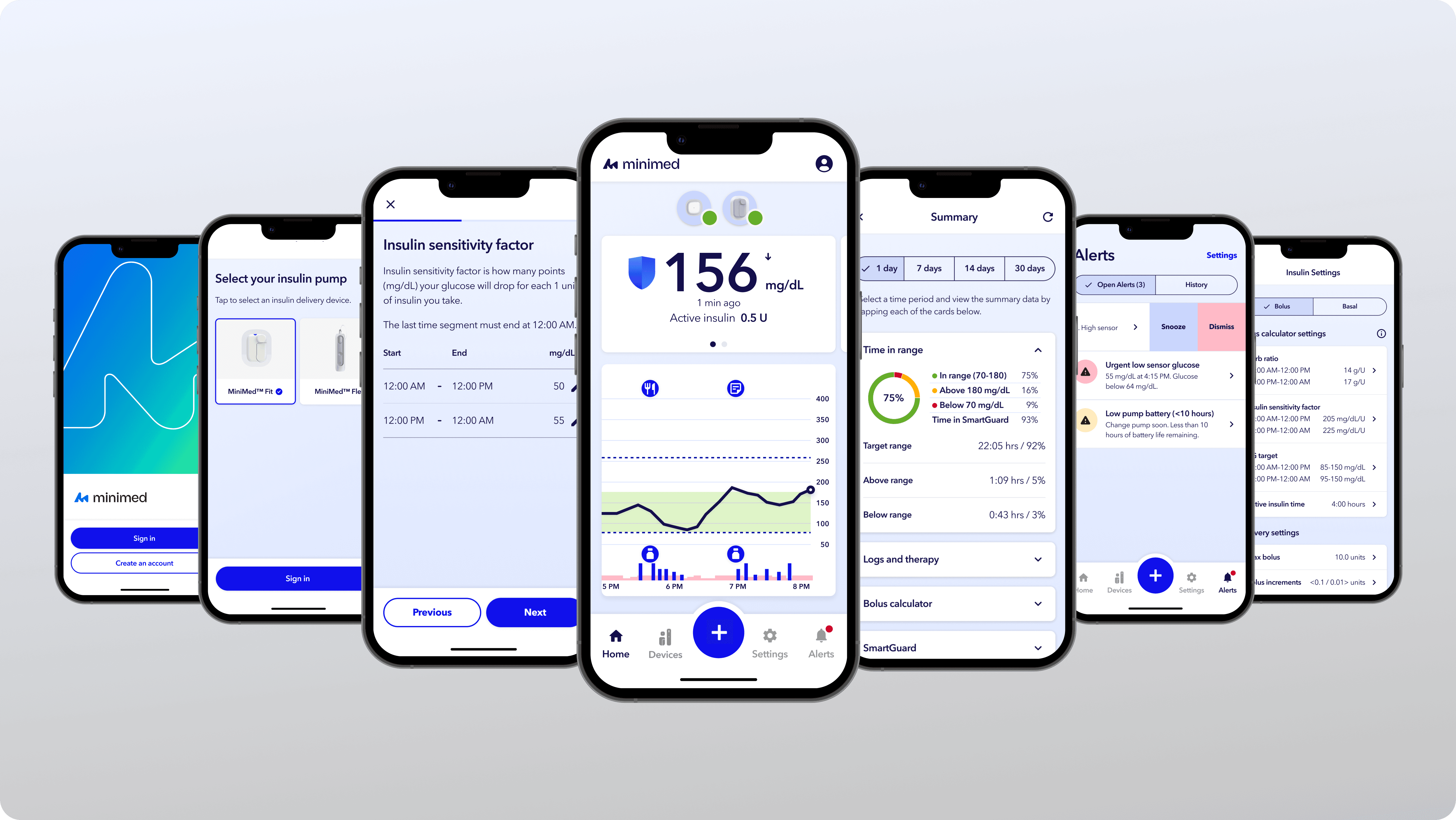
My Role
I led the end-to-end design of safety-critical features across the patch pump ecosystem.
As the only company that builds both the insulin pump and continuous glucose monitor (CGM) in-house, Medtronic manages a fully integrated therapy ecosystem within a single app. I drove the design of features within the startup, device management, error handling, notifications, therapy/prescription settings, and alert preferences flows. I partnered with systems engineering to define requirements and constraints, collaborated with clinical and safety stakeholders to ensure regulatory alignment, validated solutions through human factors testing, and delivered production-ready specifications for development.
The Core Problem
Patients with diabetes need to constantly check their health data but can't afford to add more burden in their daily routines.
They open their app dozens of times a day to manage their insulin pumps and continuous glucose monitors. They aren't just casually scrolling for a quick distraction. They are thinking, do I need to eat more sugar? Why aren't I getting any insulin? What's wrong with my pump? Can I trust what I’m seeing?
In a safety-critical system, ambiguity isn’t just confusing. It’s risky.
When blood sugar is unstable or a device unexpectedly enters a warning state, even a few seconds of uncertainty can delay intervention.
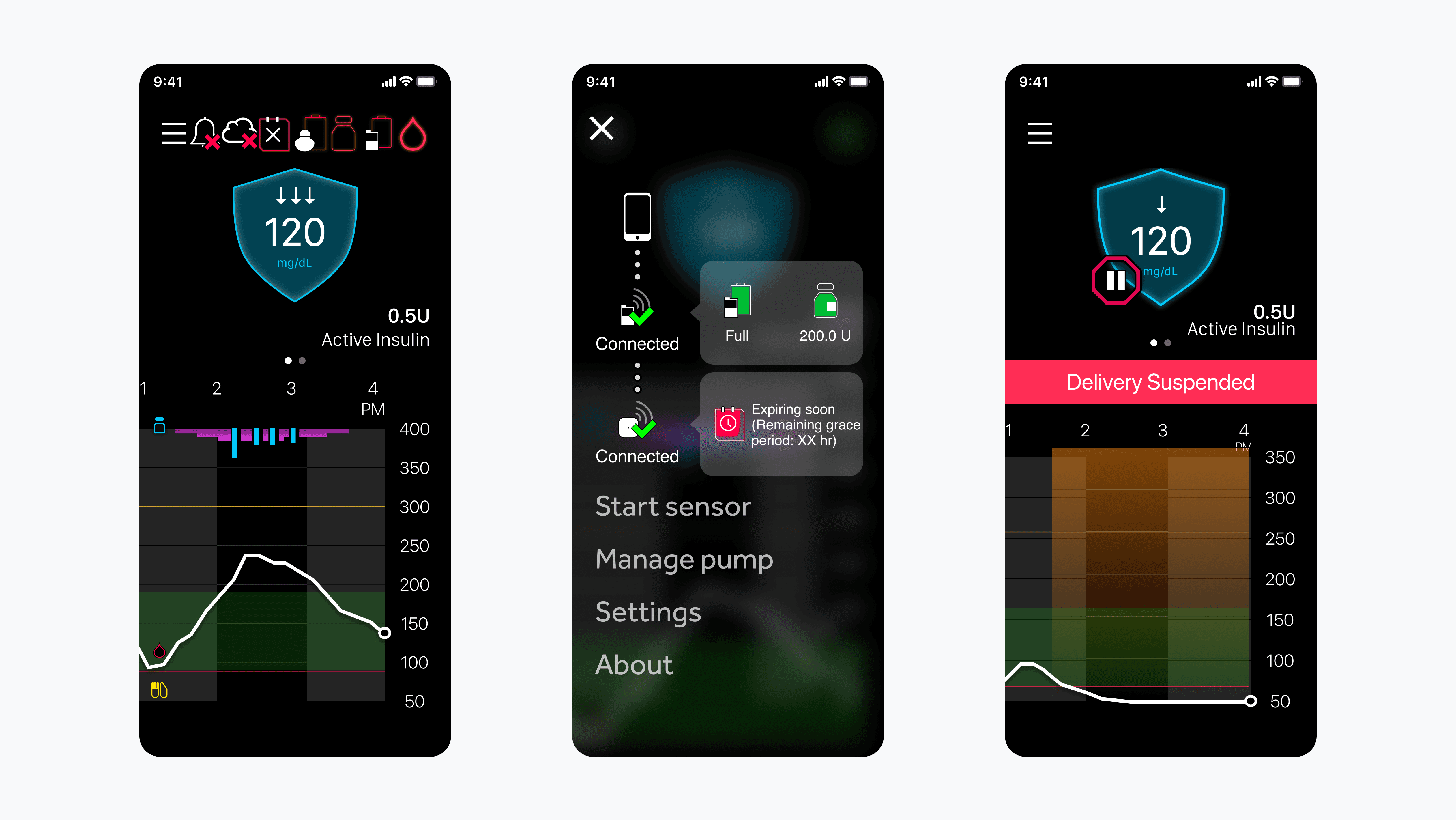
Previous Medtronic app
The previous app needed refinements:
Key device health information was buried in navigation, requiring exploration instead of quick recognition
Busy visuals and inconsistent color usage diluted the meaning of urgency cues
Severity was not clearly communicated, making it difficult to distinguish informational states from critical ones
Managing devices and resolving issues lacked clear pathways, leaving users unsure where to take action
Objectives
How can we make it immediately clear what requires action?
Patients should not have to guess whether something is urgent or simply informational.
How can we reduce mental effort during stressful moments?
When time matters, the interface should feel simple and reassuring.
How can we create a consistent experience across different products?
Products should communicate using similar logic and language to enforce familiarity and trust.
Design Process
We unified device status into a single severity language across the entire ecosystem.
To address ambiguity, I created a consistent severity system applied across alerts, modals, and device status indicators. This included standardized color usage, iconography, labeling conventions, and escalation behaviors to clearly distinguish between informational, warning, and critical states.
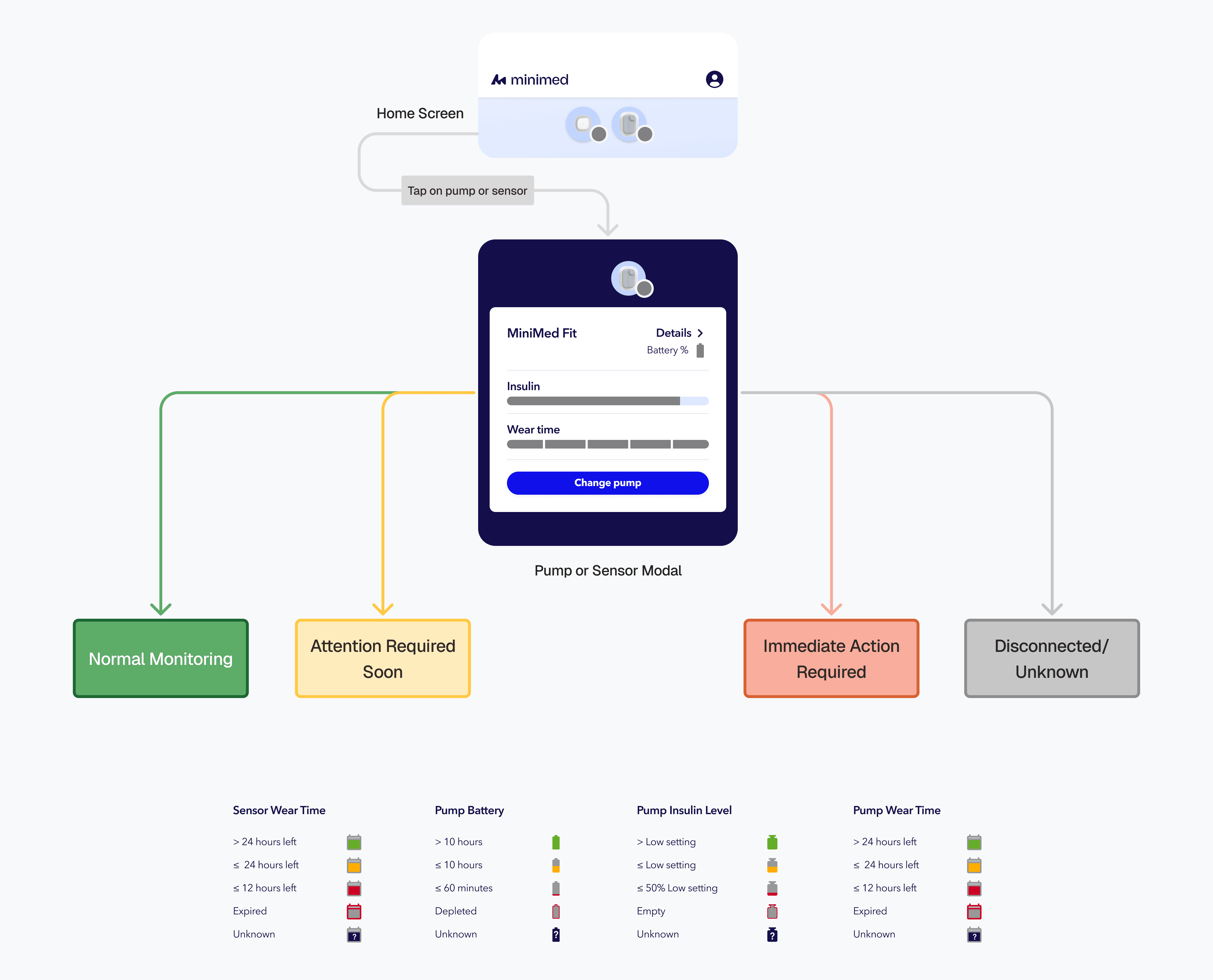
We explored multiple layout models to balance completeness and clarity.
The system contains two batteries: an active battery powering the pump and a secondary backup battery that activates when the active battery is depleted. Device info is shown so the user knows when to prepare to change their pump to avoid a pause in insulin delivery. The challenge was determining how to present the most critical information without overwhelming the primary interface. We explored different layouts:
Option A: Split Metrics
Show insulin level and wear time on one slide and battery levels for both batteries on another
Option B: Split Batteries
Each battery displayed on its own slide
Option C: Active Battery Only
Only the in-use battery shown at a glance
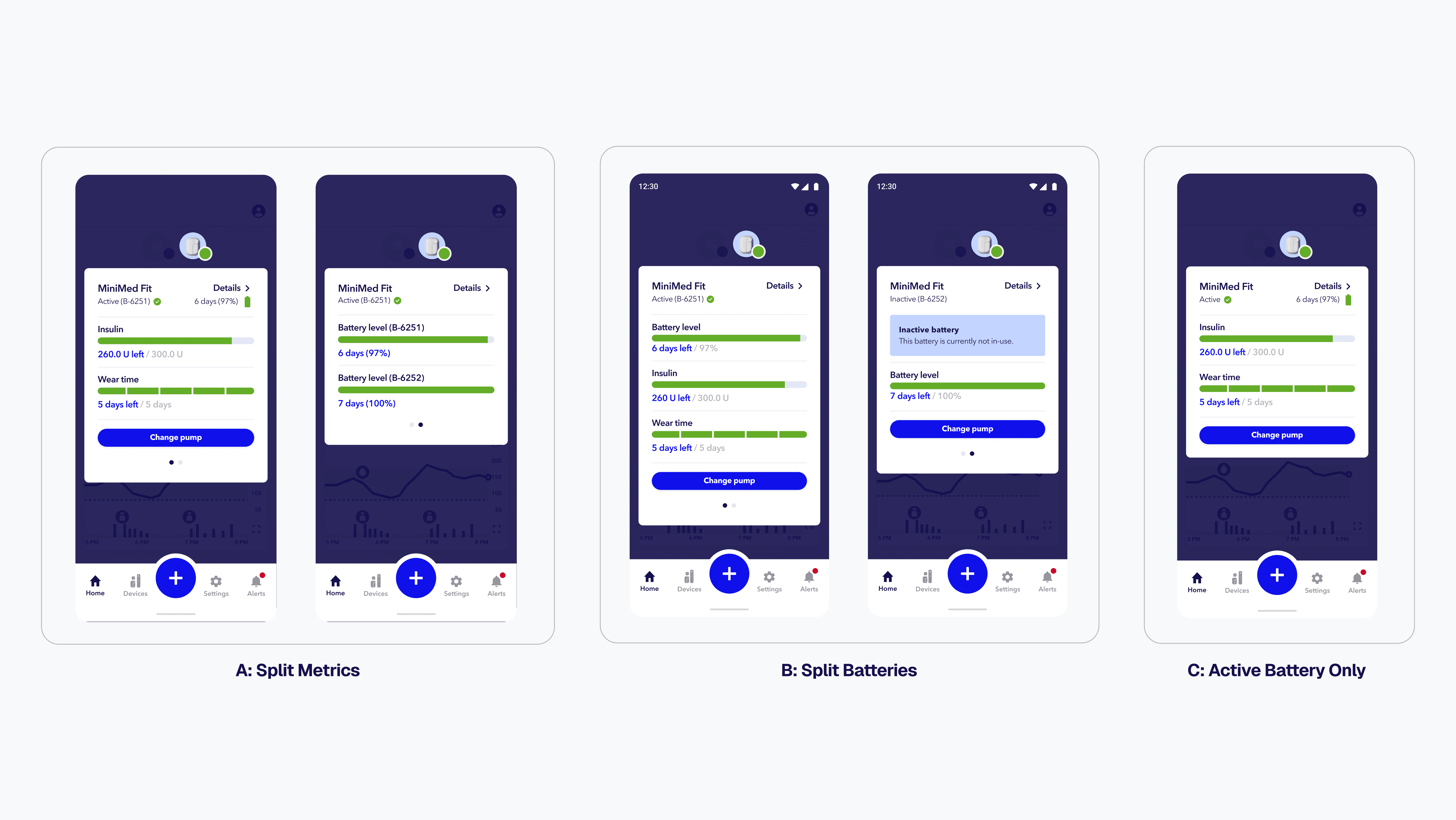
We reduced cognitive load by prioritizing the information patients actually act on.
Testing revealed that users primarily focused on the active battery and largely ignored the inactive battery during routine checks. Combined and split layouts increased scanning effort without improving decision-making.
We prioritized the Option C: Active Battery Only design, which reduced visual noise, improved glance recognition, and strengthened action clarity while preserving access to secondary information when needed.
We modeled failure states to ensure safe edge-case handling.
We didn’t just design for things breaking. We designed for real-life moments, like when it’s time to change the pump and users aren’t sure what comes next. By clarifying system states and next steps, we reduced guesswork. In usability testing, participants were able to independently navigate pump changes and resolve common errors without additional guidance.
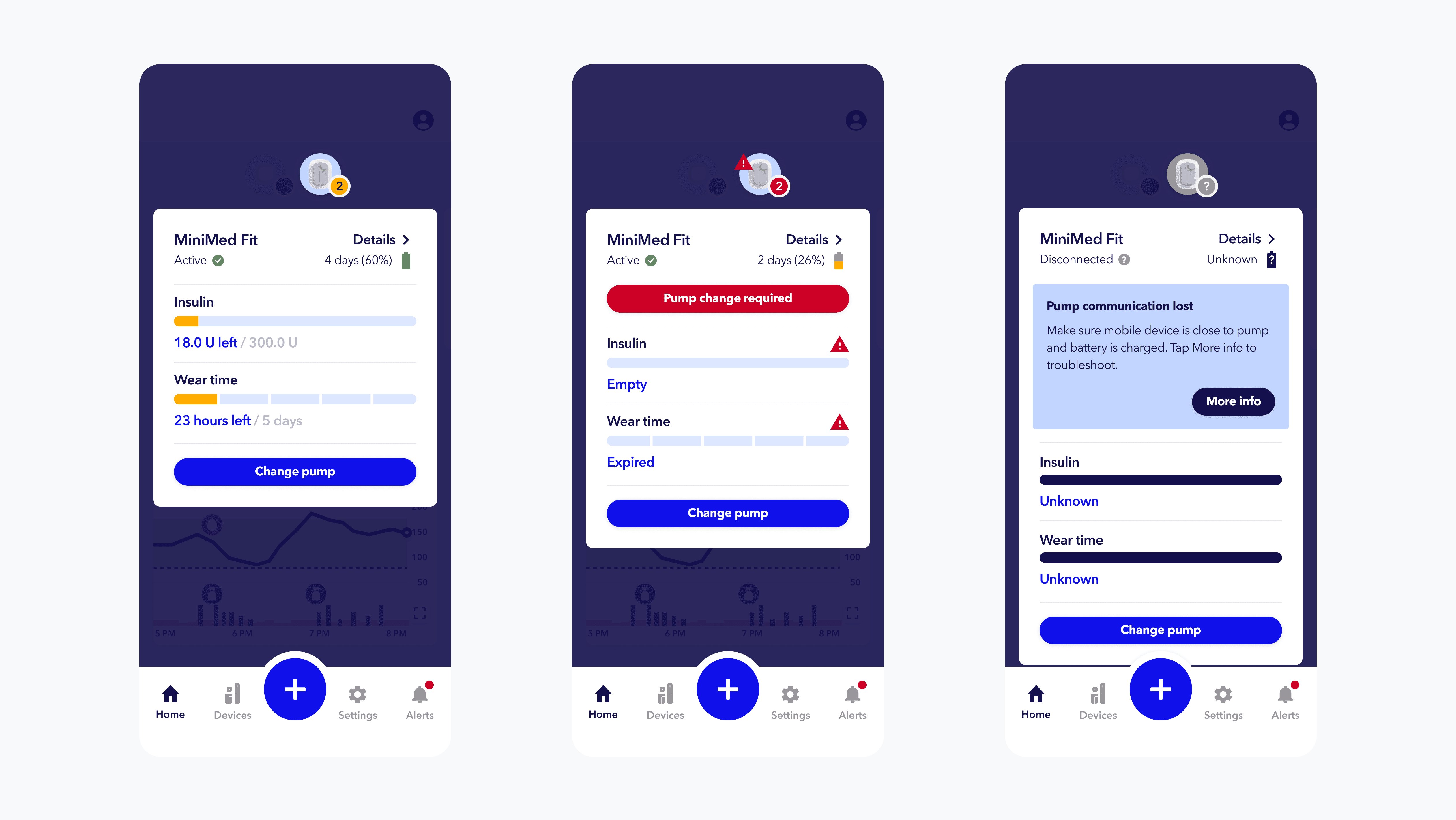
Pump modal states indicating when it's almost time to change pump
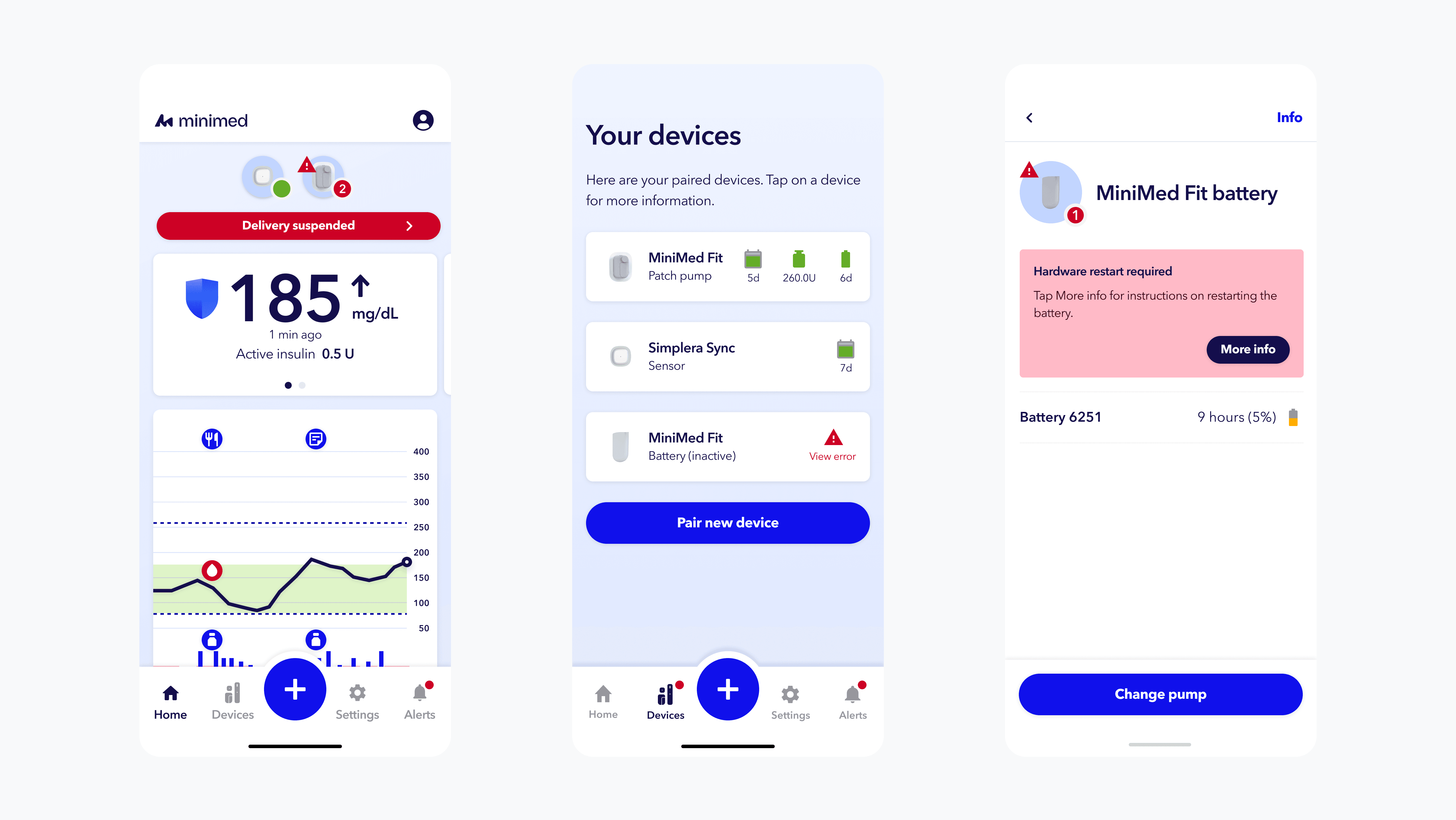
Device errors
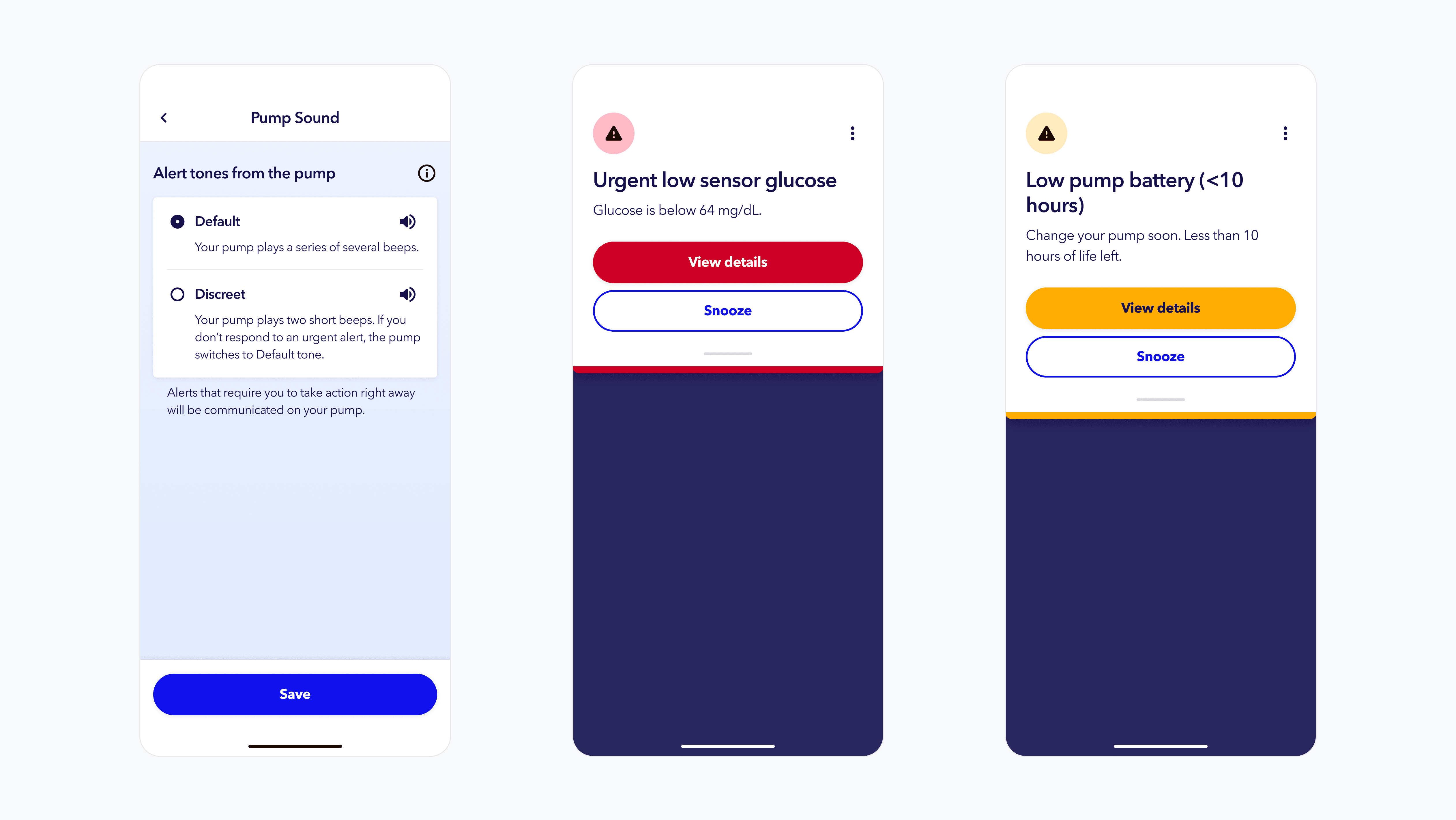
We established a clear visual and audio hierarchy for alerts.
One of the biggest pain points patients shared was alarm fatigue. Whether in a meeting or a movie theater, many said they “just wanted the pump to stop screaming.” When normal notifications carry the same visual weight or interruption patterns as critical, life-threatening alerts, users can become desensitized.
We organized alarms by urgency and made critical alerts clearly distinct, while making lower-priority notifications less intrusive. A new “discreet mode” gave users the flexibility of lowering the sound in public settings without compromising safety.
Patients shared that having control over alert settings made the pump feel less disruptive in daily life, while still keeping them protected.
We created one consistent language across the system.
Users could access device management from multiple entry points throughout the app. We aligned visual hierarchy and interaction patterns across these flows to create a consistent, predictable experience.
As a result:
Users required fewer steps to assess system health
Key device states were understood at a glance
Different levels of severity were consistent across screens
Color and icon cues reinforced urgency without requiring extra interpretation
Users did not have to relearn the system as they navigated
Outcomes
The final design strengthened clarity, safety, and trust in both users and stakeholders.
User validation showed faster recognition of action-required states, clearer differentiation between device statuses, and reduced confusion around complex system behaviors. Participants reported improved clarity in understanding overall device health.
Engineering collaboration ensured technical feasibility across software and hardware constraints, resolved edge-case error states, and coordinated timelines to keep development on track.
Stakeholder alignment ensured the severity system met FDA standards, maintained clinical accuracy, and established a shared framework across product, systems, and regulatory teams.
Together, these changes made therapy management more manageable for people living with diabetes. By minimizing confusion in time-sensitive moments, the system helped restore confidence and peace of mind in patients' lives.
UX Takeaways
Design for edge cases, not just happy paths.
Resilience is built in the “what if” moments, not the ideal ones.
Clarity over visual complexity.
For users in stressful moments, attention gets narrowed. Interfaces must prioritize signal over noise to support confident action.
Think in systems, not screens.
Interfaces are only one layer of a product. Effective design considers logic, constraints, data flows, and real-world context, ensuring changes improve the whole system, not just the UI.